UX Review Process
A framework I've used across teams: design doesn't start in a design tool, it starts with a recorded conversation nobody has cleaned up yet. An agent-run pipeline turns that raw meeting into a spec where every element traces to a quote, every number traces to data that exists, and every unknown is bracketed instead of guessed. Messy meeting in. A built design out.
- 5-step pipeline
- 7 review personas
- Agent-run
The five steps
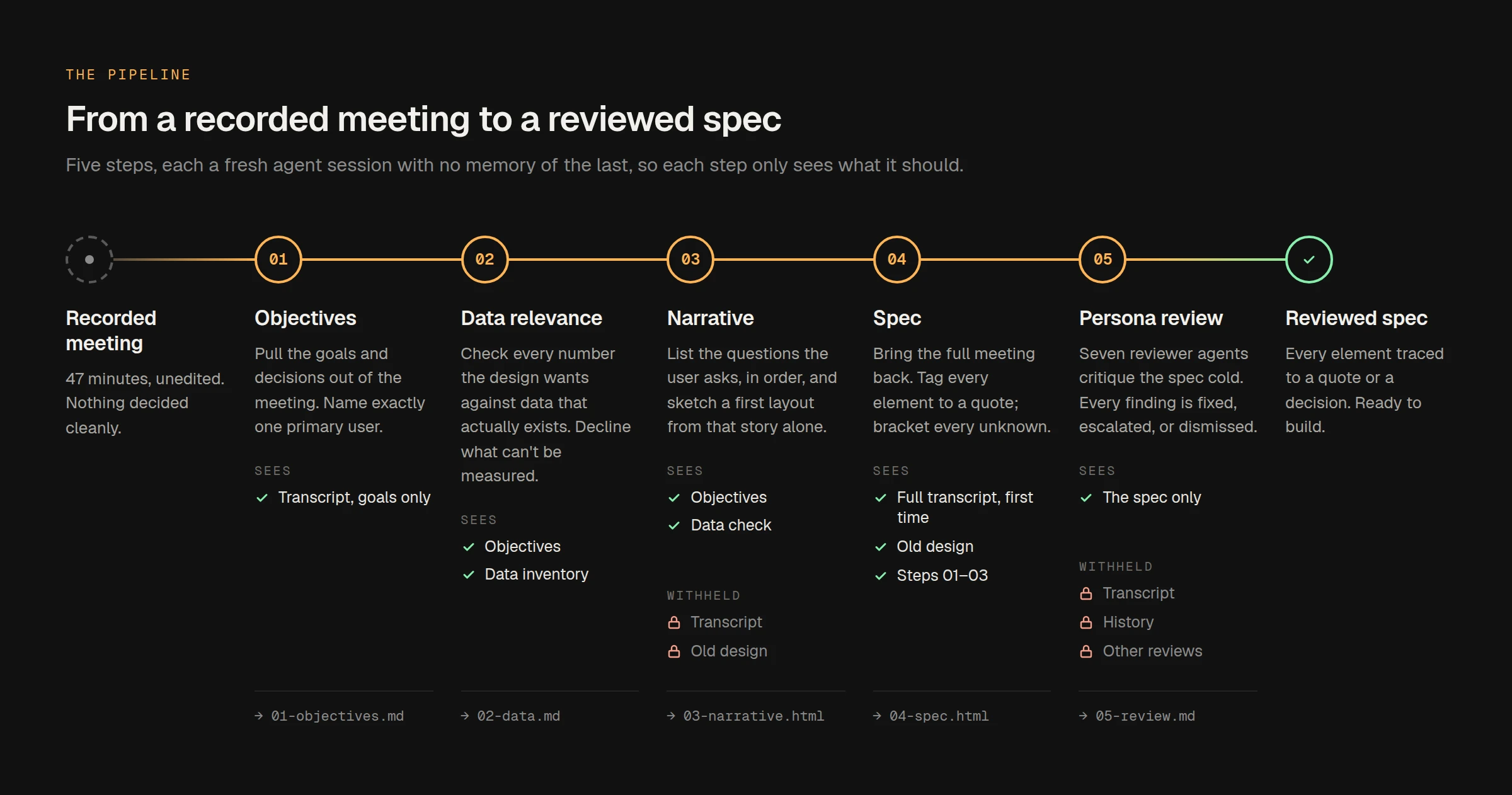
Each step runs in its own fresh session with no memory of the one before. That isolation is the load-bearing trick: material can be deliberately withheld until the stage that should see it. Process state isn't tracked in a tool; it's tracked by which numbered files exist in the folder.
- 01
Objectives→ 01-Objectives.md
Read the transcript and pull only the high-level goals and process decisions, resisting the detail, because specifics are a later stage's job. Classify the project, pick the format, and name exactly one primary user. A deliverable without a single named primary audience is not done.
- 02
Data relevance→ 02-Data-Relevance.md
Check every intended number against what the product can actually measure: measured, partial, or can't-do. Impossible asks get formally declined here instead of quietly dropped later.
- 03
Narrative wireframe→ 03-Narrative-Wireframe.html
Build the story spine first (the questions the primary user asks, in the order they ask them), then hang a first visual on it. The transcript is deliberately withheld, and for redesigns so is the old design: the first visual grows from narrative, not from the existing layout.
- 04
Spec + detail layering→ Spec-Wireframe.html
The full transcript enters for the first time, plus the old design for updates. Complete feedback coverage gets layered in as tags, the review layer, data-basis lines, and open calls: the ideal pulled toward the achievable.
- 05
Persona review→ Persona-Review-Audit.md
A panel of context-free reviewer personas audits the spec in parallel. Findings get triaged through a hard gate (implement, escalate, or dismiss with reason), and nothing moves to build until the audit comes back clean.
After step five, the reviewed spec seeds the build in a design system: a fast handoff, because the build starts from documented intent instead of a blank canvas.
The non-negotiables
Name the audience first
Every surface has exactly one primary user, and the whole artifact is judged on their behalf.
One thread wins ties
Name the single question the product exists to answer; when priorities conflict, they resolve toward it.
Trust and data basis
Every chart states its basis, adjacent figures must reconcile, and every metric traces to data that actually exists.
Don't fabricate
No invented metrics, quotes, or savings figures. A number that doesn't exist becomes a red bracket pointing at a numbered open decision.
The persona panel
Every spec faces a panel of written reviewer characters before it can become UI. Each persona is spawned as its own parallel, context-free agent: it gets its persona file, a conventions card, and the file path. No project history, no transcript, no other reviews, so it judges the spec only on what's actually on the page.
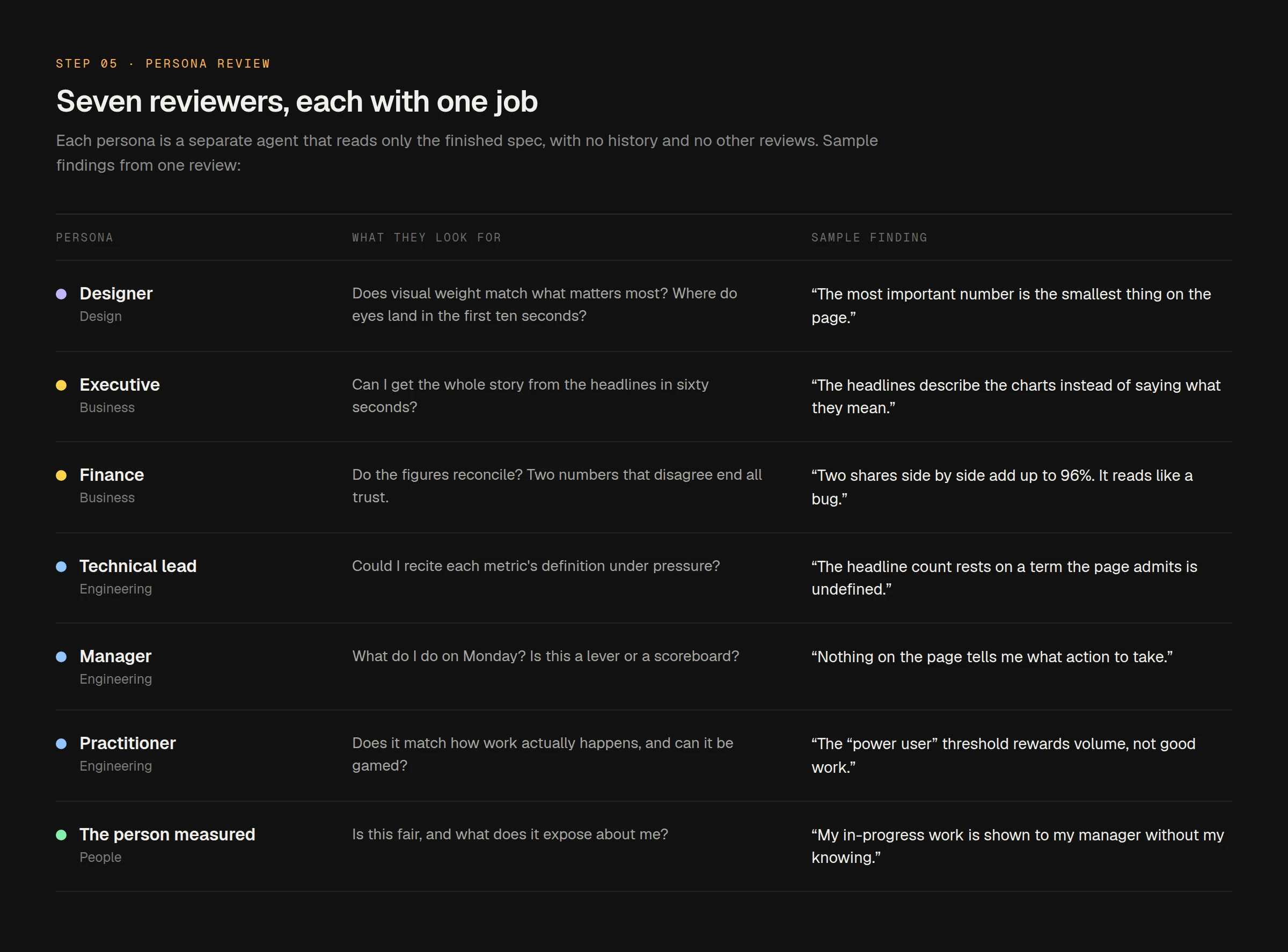
Every finding then passes a triage gate and becomes exactly one of three things: implement (a numbered decision with rationale), escalate (a red bracket and a numbered open call, never an invented answer), or dismiss with reason (recorded, so even the dismissals are auditable).
Implement, escalate, or dismiss with reason. Never invent the answer.
The annotation system
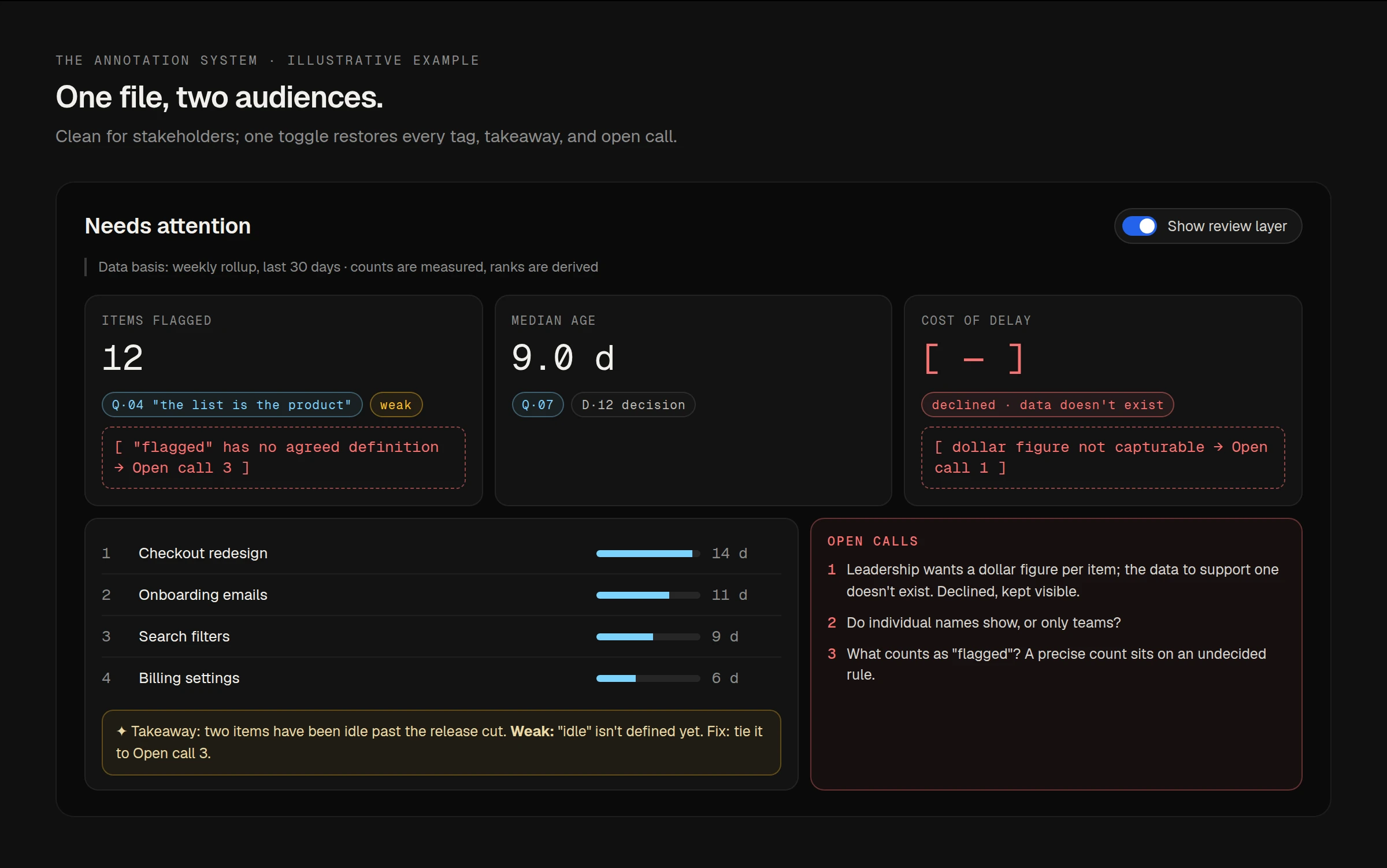
Every claim in a wireframe wears a colored tag pill; hover it and the verbatim sentence from the meeting appears. Design decisions get their own pills, so the design is the decision log. A fixed "Show review layer"toggle makes one file serve two audiences: it opens clean for stakeholders, and one click restores tags, legend, coverage table, and rationale. Takeaway strips sit under every chart, written in the audience's own voice; weak ones get flagged with a why-weak-and-fix note. Red brackets mark data that genuinely doesn't exist yet, each pointing at a numbered item in the Open Calls box, where undecided things stay red, named, and dated until somebody resolves them.
Honest unknowns beat confident fictions.
A worked example
The example is invented end to end: a made-up feature, a made-up kickoff, made-up quotes. That lets the whole framework be shown with nothing to redact.
What goes in:a 47-minute recorded kickoff for a ranked "needs attention" list. A team lead wants the list itself: "the list is the product." Leadership wants a dollar figure next to every item. Nothing is decided cleanly: the key term has no definition, one ask is flatly impossible, and nobody settles whether individual names show. This mess is the normal starting condition.
Steps 1–4distill five objectives and one audience, formally decline the dollar figure because the data to support it doesn't exist, catch two sources contradicting each other, build the ideal with the transcript withheld, then layer back ninety-plus tag pills, seventeen coverage-checked source asks, and twenty-eight numbered decisions.
Step 5 is where it gets uncomfortable. Five context-free reviewers land twelve consensus findings. The technical personas independently hit the same flaw: a precise, trended headline count sitting on a definition the page itself admits is undecided. And the persona for the people being measured finds what nobody in the meeting raised: the surface exposes their in-progress work and never tells them what it says about them. Triage: 14 implemented, 15 escalated, 2 dismissed with reason.
A count cannot be more resolved than its own definition.
96
Tag pills
17
Source asks traced
28
Numbered decisions
10
Open calls kept open